
Best leak repair in San Diego: how to choose
Picking the best leak repair in San Diego comes down to equipment, slab and copper experience, and a written scope. Here's how to vet a leak specialist.
The short answer
- Leak repair is a specialty; you want a detection specialist with real equipment, not a generalist who guesses.
- Ask what tools they bring: acoustic listening, thermal imaging, tracer gas, moisture meter, and a pressure test rig.
- Detection and repair are separate invoices; never accept a flat repair price before the leak is located.
- Older San Diego homes get slab leaks and pinhole copper leaks; a true specialist pressure-tests the whole system, not just one spot.
- Insurance covers the water damage, not the pipe repair; get a written report for your adjuster. Call (858) 925-5546.
Leak repair isn’t a generalist skill. It’s a specialty. Most plumbers can swap a water heater or rod a drain. Far fewer can actually find a hidden leak without tearing your house apart. When you search for the best leak repair in San Diego, you’re really shopping for two things at once: a detection specialist with the right equipment, and a repair plumber with real slab and copper experience.
This guide walks you through what to look for, what to ask, and what should make you walk away. It’s written for San Diego homeowners because the housing stock here has its own quirks. Post-tension slabs from the 1960s through 1990s. Copper that’s reached the back end of its life. Hard water that accelerates pinhole corrosion. The right plumber for a leak in Mira Mesa or La Jolla isn’t always the right plumber for a sewer cleanout.
Leak detection equipment that signals capability
The fastest way to filter leak plumbers is to ask what equipment they use. A real leak detection specialist will name several tools without hesitation. A generalist will say “we’ll find it” and start guessing.
Here’s what you want to hear.
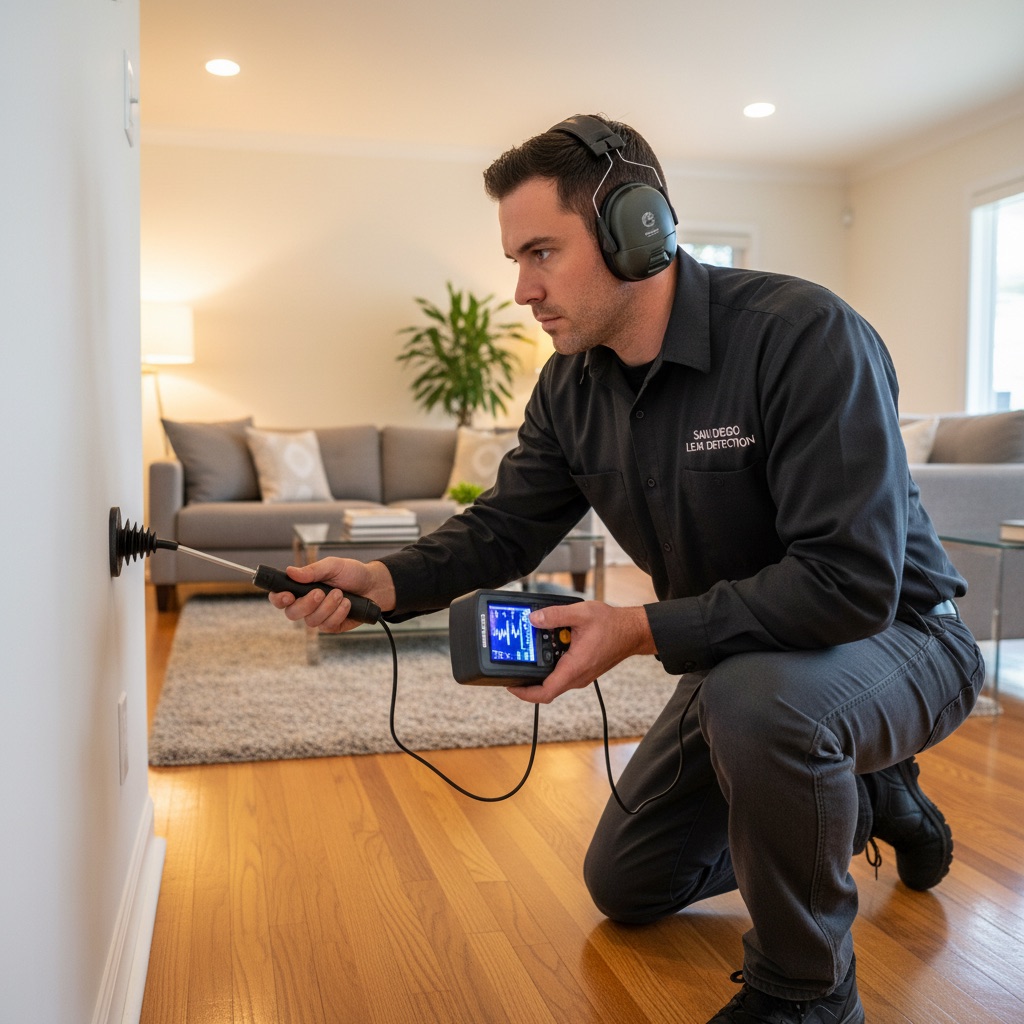
Acoustic listening device. This is the workhorse for pressurized water lines. The technician puts a sensitive microphone on the floor or wall and listens for the high-frequency hiss of water escaping under pressure. Done right, it pinpoints a leak to within a few inches. Done wrong, it sends a crew through the wrong section of drywall.
Thermal imaging camera. Hot water leaks show as warm plumes on slab or behind walls. A thermal camera spots them in seconds. It’s also useful for finding the actual path of a hot water line so the repair stays minimal.
Tracer gas. When acoustic doesn’t work, specialists pump a safe gas mixture (helium or hydrogen blends) into the pressurized line and use a sniffer to find where it escapes. This is the gold standard for hard-to-find leaks, especially on quiet, slow drips.
Moisture meter. A handheld meter that reads moisture content through drywall, flooring, and baseboards. It maps the wet zone so the plumber knows where the water has traveled, not just where it started.
Pressure test rig. Isolates sections of pipe and pressurizes them with air or water to confirm whether a section holds. This is how a good plumber proves the leak is on the hot side, the cold side, or in a specific zone before they cut anything.
Dye test. Cheap, fast, and still useful for toilets, showers, and pool plumbing. A specialist still keeps this in the truck because it’s the right tool for certain jobs.
If a plumber rolls up with only a stethoscope and a flashlight, you’ve found a generalist, not a leak specialist.
Detection cost vs repair cost: two different invoices
A lot of San Diego homeowners get burned here. Detection and repair are separate services. They should be quoted separately.
Detection is the diagnostic work. Acoustic survey, thermal scan, pressure test, locating the leak on a drawing or photo. In San Diego, that usually runs in a known range and gets quoted as a flat fee or a defined window before the plumber starts.
Repair is the actual fix. Spot repair, reroute, partial repipe, full repipe. The scope can’t be honestly priced until detection is done. Any plumber quoting a flat repair price before they’ve located the leak is guessing, and guessing favors them, not you.
Ask for the split in writing. You want to know exactly what detection costs, what’s included, what happens if the leak isn’t found on the first visit, and how the repair quote will be structured once the leak is confirmed.
Slab leaks: the specialty SD plumbers should have
Most San Diego homes built between 1960 and 1990 sit on post-tension concrete slabs with copper supply lines embedded in or under the slab. That construction style created a long list of leak patterns that local plumbers should know on sight.
Formicary corrosion zones. Copper in contact with certain soil chemistries and trace chlorides develops microscopic ant-nest corrosion from the outside in. Whole neighborhoods in San Diego sit on soil that promotes it. A specialist knows the zones and the signs.
Multi-leak scenarios. Once copper starts to fail on a slab, it rarely fails in just one spot. A good plumber will tell you up front that finding one leak doesn’t mean there isn’t a second one developing twenty feet away. They’ll pressure-test the full system, not just patch the obvious spot.
Post-tension cable awareness. Cutting into a post-tension slab without locating the cables first is dangerous. A specialist will either avoid the cut entirely by rerouting overhead, or scan the slab with ground-penetrating equipment before breaking concrete.
If the plumber doesn’t bring up any of this, ask them directly how they handle slab leaks in older San Diego homes. Their answer tells you everything.
Pinhole leaks in copper: another SD specialty
Pinhole leaks are the second leak pattern that defines San Diego plumbing. They’re tiny perforations in copper pipe, usually from the inside out, caused by water chemistry and pipe age. You’ll see them most often in homes 30+ years old with original copper.
The judgment call a specialist makes is this: spot-repair, partial repipe, or full repipe.
Spot repair makes sense when you have one leak, the rest of the system pressure-tests clean, and the copper still has plenty of life. Partial repipe makes sense when one wall or one run is failing but the rest is fine. Full repipe is the right call when you’ve had multiple pinhole leaks in different parts of the house within a year or two.
A specialist will lay this out plainly and give you the cost trade-offs. A generalist will quote the smallest fix and you’ll see them again in six months.
For the full breakdown of when a repipe pays off, see copper repipe cost in San Diego.
Hidden wall leaks: detection without destruction
Nobody wants their drywall opened. A good leak plumber doesn’t want to open it either. The whole point of investing in detection equipment is to keep the repair cut as small as possible.
Non-destructive methods come first. Acoustic and thermal scans through the wall. Moisture mapping. Pressure isolation to confirm which line is leaking. Borescope camera through a small hole if needed. By the time the plumber cuts drywall, they should be able to point to a spot the size of a hand and say “the leak is right there.”
Sometimes the cut is unavoidable. Cast-iron drain leaks behind a tub, for example, don’t always show up on acoustic. In those cases the specialist explains why, where the cut will go, how big it’ll be, and what restoration looks like after.
If a plumber wants to open a four-foot section of wall as their first move, that’s not detection. That’s demolition.
Outdoor and irrigation leaks
Outdoor leaks need a different toolkit. The acoustic environment is louder, the soil absorbs sound, and the leak might be on a section of pipe that’s actually owned by the City of San Diego, not by you.
The lateral confusion is real. In most San Diego neighborhoods, the homeowner owns the water service line from the meter to the house. The City owns everything on the street side of the meter. If the leak is on your side, it’s your repair. If it’s on the City side, you call them, not a plumber.
A specialist will help you figure out which side the leak is on before quoting work. They’ll also know when an irrigation backflow assembly is the actual culprit. Backflow leaks get blamed on the mainline all the time. They show up in your water bill the same way but cost a fraction to fix.
Ground microphones, soil probes, and sometimes a hose-bib pressure test are the right tools here. If the plumber doesn’t have them, they’re guessing in your yard.
What to ask before they tear into a wall
Before any cut happens, get answers to these:
- What non-destructive methods have you already used to confirm the leak location?
- Can you show me the acoustic, thermal, or camera footage?
- Exactly where will the cut be and how big?
- What’s the written repair scope and price?
- Who handles drywall, tile, and flooring restoration after?
- If the leak isn’t where you expect, what happens to the quote?
- How will you dry the wet area to prevent mold?
A leak specialist has clean answers ready. They’ve been asked all of this before.
Red flags in a leak quote
Walk away from any of these:
- A repair price quoted before the leak has been located.
- “We’ll figure it out when we get into it.” That’s a blank check.
- No written estimate. Verbal numbers turn into bigger numbers on the invoice.
- Refusing to show you the camera, thermal, or moisture data they used.
- Pressure to sign same-day on a major repipe before you’ve had a chance to review.
- Vague scope language. You want lines like “spot repair on hot water line at kitchen wall, 4-inch drywall cut, repair to copper with sweat-fitted coupling.” Not “fix leak.”
- No mention of how they’ll dry the wet area or coordinate restoration.
The pattern is always the same. Vague scope plus pressure plus no documentation equals a job that grows on you.
Insurance coordination
This is where leak specialists really separate from generalist plumbers. Most homeowners insurance policies cover the resulting water damage from a sudden leak, but not the leak itself or the plumbing repair. The split matters because the documentation has to be clean.
A good leak plumber will give you a written report with the cause of loss, the location, photos, and the scope of the leak repair as a separate line from any restoration. That report is what your adjuster needs to approve the damage claim.
A generalist usually hands you a one-line invoice that says “plumbing repair” and your claim stalls.
For more on the coverage side of this, see does homeowners insurance cover plumbing leaks.
Questions to ask before you hire
Use this list when you call around:
- Do you specialize in leak detection or is it part of general plumbing for you?
- What equipment will you bring to the first visit?
- Is detection priced separately from repair?
- How do you handle slab leaks in older San Diego homes specifically?
- Will you provide a written report I can send to my insurance company?
- Can I see photos or video of the located leak before you cut?
- What’s your warranty on the repair?
- Who restores the drywall, tile, or flooring after?
If any of those answers feel scripted, evasive, or rushed, keep dialing.
Related reading
- When to call a plumber for a water leak in San Diego
- Slab leak repair in San Diego
- Signs of a hidden water leak
- High water bill, no visible leak
- High water bill, no leak you can find
- Leak repair cost in San Diego
- Pipe leak repair in San Diego
- Burst pipe repair in San Diego
- Plumbing leak data for San Diego, 2026
FAQ
How do I know if a plumber is actually a leak specialist?
Ask what detection equipment they bring on the first visit. A specialist will name acoustic, thermal, moisture, and pressure tools without thinking. A generalist will say “we’ll figure it out.”
Should detection cost less than repair?
Usually yes. Detection is a flat or windowed fee. Repair scales with scope. The two should always be quoted as separate line items.
Is it normal to have more than one slab leak?
In older San Diego homes with original copper, yes. Once one leak shows up, the rest of the system has to be pressure-tested to rule out others. A specialist brings this up before you do.
Can a plumber find a leak without cutting drywall?
Most of the time, yes. Acoustic, thermal, and moisture tools combined will locate a leak to within inches before any cut happens. If a plumber wants to open the wall first, that’s a red flag.
Who’s responsible for the outdoor water line, me or the City of San Diego?
You own the line from the water meter to your house. The City owns everything on the street side. If you’re not sure which side the leak is on, a leak specialist can confirm before quoting work.
Will my homeowners insurance cover the leak?
It usually covers the resulting water damage from a sudden leak, but not the pipe repair itself. A good leak plumber gives you a written report your adjuster can use to approve the damage claim.
Need a second opinion on a leak?
If you’ve already had one plumber out and the answer felt off, get another look before you sign anything. Call Plumbing Pro San Diego at (858) 925-5546. We’ll bring the equipment, locate the leak, and lay out your options in writing before any wall comes open.
Need a Plumber in San Diego?
Licensed, insured, and available 24/7 across San Diego County. Upfront pricing, no surprises.
Call (858) 925-5546Available 24/7, no voicemail, no answering service