
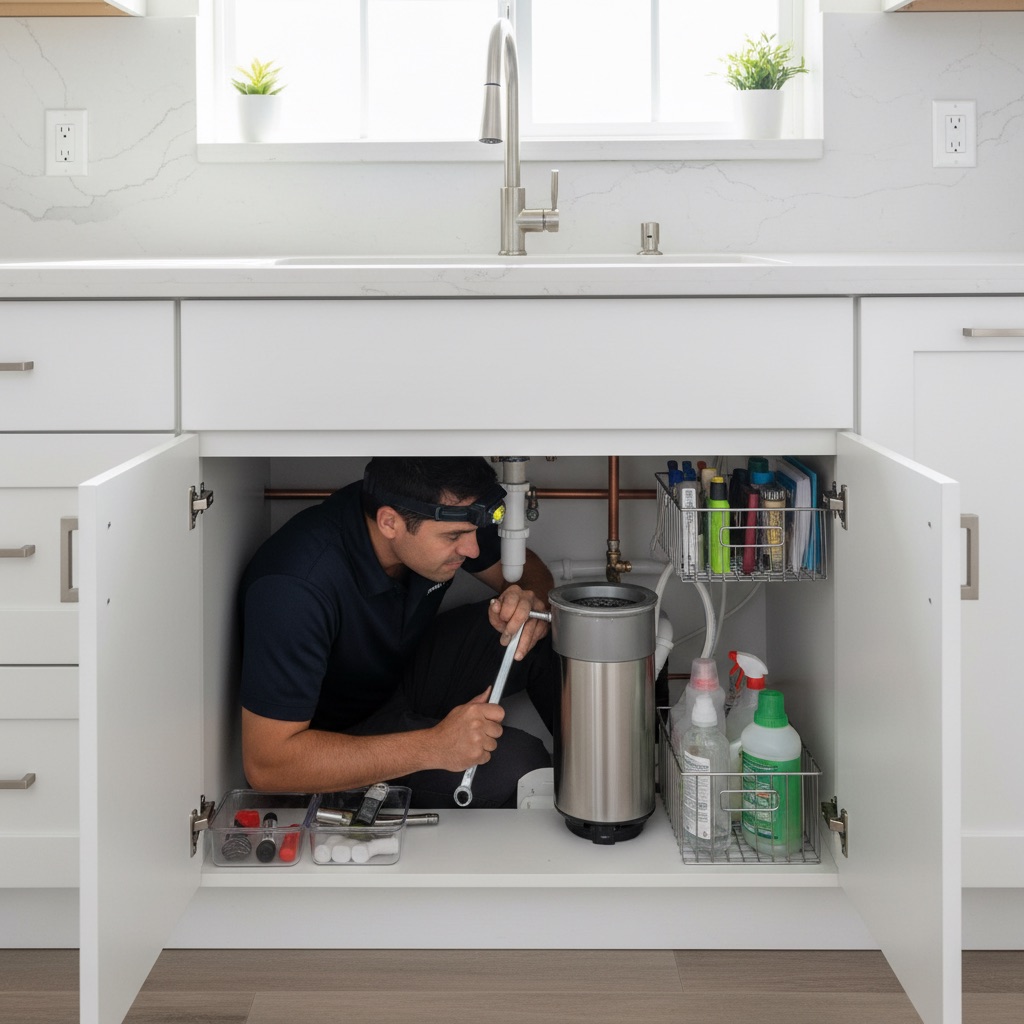
Garbage Disposal Not Working? Fix It in 10 Minutes
Garbage disposal not working? Diagnose hum, silence, slow drain, or leak in 60 seconds. Step-by-step fixes by brand, plus when to call a San Diego plumber.
The short answer
- Diagnose by sound: humming means a jammed flywheel, silence means lost power, slow drain means a downstream clog.
- For a hum, cut power, work a 1/4-inch hex key in the bottom socket, clear debris with tongs, then hit reset.
- For silence, press the reset button, check the breaker, and test the wall switch and under-sink outlet in order.
- Water from the bottom means a failed motor seal; replace the unit ($200 to $450 installed) rather than repair it.
- Top and side leaks (sink flange putty, hose clamps) are repairable. Call (858) 925-5546 for same-day help.
Your garbage disposal just quit. Before you call anyone, most failures fall into three buckets, and you can sort them in under a minute. A motor that hums but won’t spin means a jammed flywheel. Dead silence means lost power or a tripped reset. Water under the cabinet means a failed seal, and where the water sits tells you which one.
This is the diagnostic walkthrough we use on service calls in San Diego. Work through it in order. You’ll either fix it yourself in ten minutes or know exactly what to tell a plumber when you call.
First, identify which failure you have
Turn the disposal on and listen. One of five things is happening.
It hums but the blades don’t turn. The motor has power but the flywheel is jammed. This is the most common failure, and it’s usually a five-minute fix at the sink.
It makes no sound at all. The motor has no power. Either the internal overload tripped, the breaker tripped, or the wall switch failed.
It runs but the sink drains slowly or backs up. The disposal works, but something downstream is clogged. Could be the disposal chamber, the P-trap, or the dishwasher discharge.
Water is pooling under the cabinet from the bottom of the unit. The internal motor seal failed. Disposals aren’t worth resealing. You’re replacing it.
Water is leaking from the top where the disposal meets the sink, or from the side hoses. The sink flange putty dried out, or a hose clamp slipped. Both are repairable.
Pick the one that matches and jump to that section.
Humming but won’t spin (jammed flywheel)
This is fixable at the sink. You’ll need a 1/4-inch hex key, which most disposals ship with and most people lose in a drawer. Any hardware store sells them for two dollars.
Step 1. Turn the wall switch off. Then unplug the disposal under the sink, or flip the breaker for the kitchen at the panel. Never work on a disposal that has power to it.
Step 2. Look at the bottom center of the disposal. You’ll see a hex-shaped hole. Insert the 1/4-inch hex key, push up firmly, and rotate it back and forth. You’re manually spinning the flywheel to dislodge whatever is wedged against the impellers.
Step 3. When it spins freely in a full circle both directions, pull the key out. Reach into the sink with a flashlight and tongs or pliers, never your fingers, and remove whatever you can see. Common culprits we pull out: peach pits, chicken bones, twist ties, and the small plastic ring from a milk jug cap.
Step 4. Push the red reset button on the bottom of the unit. It will click in and stay flush. If it’s already flush, it was never tripped.
Step 5. Restore power. Run cold water. Flip the switch. It should spin freely.
If it still hums, the flywheel is corroded to the impeller plate. We see this on coastal homes from Encinitas down to Imperial Beach where salt air gets pulled under the sink, and on inland homes where hard water leaves mineral deposits that freeze the flywheel after a long vacation. Sometimes a few more rounds with the hex key and a cup of white vinegar poured into the chamber will free it. Sometimes it won’t, and the unit is done.
Dead silent (no power, no hum)
If you hear nothing when you flip the switch, work backward from the unit to the panel.
Press the reset button first. It’s on the bottom of every disposal, usually red, sometimes black. Location varies slightly by brand.
- InSinkErator Badger and Evolution: dead center of the bottom, red button.
- Waste King: bottom of the unit, smaller red button slightly off-center.
- Moen GX and GXS series: bottom center, red.
- KitchenAid: bottom, red, often recessed in a small well.
- GE: bottom center, red.
Press it. If it stays in, you’ve reset the overload. Run cold water and try the switch.
Check the breaker. Open your electrical panel. The kitchen disposal usually shares a breaker with the dishwasher or a kitchen counter circuit. If a breaker is sitting between on and off, flip it fully off, then back on.
Test the wall switch. Switches fail more often than people think, especially the cheap builder-grade ones in older San Diego homes. Plug a lamp into a known-working outlet and use a voltage tester on the disposal switch leads if you have one. If you don’t, the simpler test: does the switch click crisply, or does it feel mushy and loose. A mushy switch is a failed switch.
Check the outlet under the sink. Most disposals plug into an outlet inside the cabinet, with the wall switch controlling power to that outlet. Unplug the disposal and plug in a lamp or phone charger. If the lamp lights when you flip the switch, the outlet works and the disposal is dead. If the lamp doesn’t light, the switch or the wiring is the problem.
If reset, breaker, switch, and outlet all check out and the disposal is still silent, the motor is burned out. Replace the unit.
Slow drain with the disposal running
The disposal works, but water backs up into the sink. The clog is somewhere in the drain line, and the question is where.
Test 1: is it the disposal chamber. Turn off the disposal. Look down into it with a flashlight. If you see standing water sitting in the chamber, the discharge tube or the line just past it is clogged. Run the disposal for ten seconds with full cold water. If the water level drops and then drains, you’re fine. If it sits, move to step 2.
Test 2: is it the dishwasher loop. Many San Diego homes have the dishwasher drain hose looped through the disposal’s dishwasher inlet. If that hose is clogged or the inlet plug was never knocked out during install, water backs into the disposal. Pull the hose, check for grease buildup, and clear it.
Test 3: is it the P-trap. Place a bucket under the P-trap, the curved pipe just past the disposal discharge. Loosen the slip nuts by hand or with channel-lock pliers. Pull it off. If it’s packed with grease and food, that’s your clog. Rinse it in another sink and reinstall.
Test 4: is it past the P-trap. If the trap is clean and the line still backs up, the clog is in the branch drain or the main line. That’s a snake job. A 25-foot drum auger from a hardware store will reach most kitchen clogs. If the clog is past 25 feet or the line keeps reclogging, the branch needs professional clearing.
Leaking from the bottom (motor seal failed)
If water is dripping from the very bottom of the disposal housing, the internal motor seal is gone. Water has gotten into the motor windings.
This isn’t worth repairing. The seal isn’t a serviceable part on residential disposals, and once water has reached the motor, it’s a matter of weeks before the motor shorts out. Replace the unit. A standard 3/4 HP disposal runs $150 to $250 at a home center, and installed cost in San Diego is $200 to $450. See our garbage disposal replacement cost guide for what to expect.
Leaking from the top (sink flange)
Water beading up where the disposal mounts to the sink means the plumber’s putty seal under the sink flange has dried out and cracked. Common on disposals older than five years, and accelerated in San Diego by hard water mineral deposits that wick water under the flange.
The fix is straightforward but takes about an hour.
Unplug the disposal. Disconnect the discharge tube and dishwasher hose. Twist the disposal off the mounting ring, support it, set it aside. Loosen the snap ring and backup ring under the sink, push the flange up through the sink hole, and scrape the old putty off both the sink and the flange.
Roll a fresh rope of plumber’s putty about the thickness of a pencil and press it around the underside of the flange. Drop the flange back into the sink hole, press down evenly, and reassemble the mounting hardware. Wipe the putty squeeze-out from inside the sink. Reattach the disposal. Run water for a minute and check.
Leaking from the side (dishwasher hose or discharge tube)
Two clamps on the side of every disposal: the dishwasher inlet at the top, the discharge tube on the side. Both use hose clamps, and both work loose over time.
Look for the wet spot. Dry the area with a paper towel, then watch where the water comes back. If it’s the dishwasher hose, tighten the spring clamp with pliers or replace it with a worm-gear clamp. If it’s the discharge tube where it bolts to the disposal, the rubber gasket inside has compressed. Loosen the two bolts, replace the gasket, retighten evenly.
If the discharge tube itself is cracked, swap it for a new one. Universal kits at any hardware store run about $8.
San Diego specific failure patterns
A few things we see more often locally than national guides cover.
Hard water mineral lock. San Diego water runs 15 to 20 grains per gallon. Disposals that sit unused for a week or more, like at vacation homes or seasonal rentals, develop a thin calcium layer that fuses the flywheel to the impeller plate. Symptom: humming on day one of arrival, fine after a vinegar flush.
Coastal corrosion. Homes within a few miles of the coast pull salt-laden air into the cabinet under the sink. Older steel-housing disposals corrode at the motor seam from the outside in. If yours looks rust-streaked, it’s living on borrowed time.
Yard runoff clogs. Eucalyptus seed pods, jacaranda blossoms, and palm debris track into kitchens from outdoor entertaining and end up in disposals where they don’t belong. The pods are dense enough to jam an impeller. If you’ve been hosting outside and the disposal jams, that’s probably what’s wedged.
When to call a plumber
You’ve worked through this and the disposal isn’t fixed. Call when:
The motor smells burned, like overheated electrical insulation. The windings are toast. Don’t keep flipping the switch.
The flywheel won’t free up after multiple hex-key sessions and a vinegar soak. Something inside is bent or corroded shut.
You can’t isolate where a leak is coming from. Water travels under cabinets, and the visible drip rarely marks the source.
You’ve cleared the same clog twice in a month. The branch drain or main line has buildup that needs snaking past the reach of a consumer auger.
The disposal is over ten years old and has needed two repairs in the last year. You’re past the point where parts make sense. See our garbage disposal repair guide for the repair-versus-replace decision.
FAQ
Why does my garbage disposal hum but not spin? The flywheel is jammed. Cut power, insert a 1/4-inch hex key into the bottom of the unit, and rotate it back and forth until the flywheel spins freely. Clear any debris from the chamber and press the reset button.
Where is the reset button on my disposal? On the bottom of the unit, in the center or just off-center. It’s usually red. Brands vary slightly in placement: InSinkErator and Moen are dead center, Waste King is offset, KitchenAid is recessed in a small well.
Can I pour chemical drain cleaner into a garbage disposal? No. The chemicals corrode the rubber seals and the metal impellers, and they’re rarely effective on the food-and-grease mix that clogs disposals. Use a plunger, a hex key, or pull the P-trap instead.
How long should a garbage disposal last in San Diego? Eight to twelve years for most units. Hard water and coastal salt air shorten that range. If yours is past ten years and starting to fail, replacement is usually the better call than repair.
Should I replace the disposal myself or hire a plumber? If the electrical wiring is in good shape and you can lift 15 pounds overhead while working on your back under the sink, it’s a DIY job. If the wiring needs updating, the mounting ring is corroded, or the discharge plumbing needs rework, hire it out. Most San Diego installs run $200 to $450 all in. See our plumber cost guide for the rate breakdown.
Need help fixing it
If you’ve worked through this and the disposal still won’t run, or you’d rather skip the under-sink contortions, our garbage disposal repair team covers all of San Diego County and most service calls are same-day. Call (858) 925-5546 and we’ll diagnose it on site, give you a flat price before any work starts, and either repair or replace depending on what makes sense for the unit.
Related reading: garbage disposal maintenance, garbage disposal repair in San Diego, garbage disposal replacement cost, can a plumber install a dishwasher, how much does a plumber cost in San Diego.
Need a Plumber in San Diego?
Licensed, insured, and available 24/7 across San Diego County. Upfront pricing, no surprises.
Call (858) 925-5546Available 24/7, no voicemail, no answering service