How often should sewer lines be cleaned in San Diego?
How often to clean your main sewer line in San Diego. Frequency by home age, pipe type, and neighborhood. Root-prone lots, clay pipes, and warning signs.
The short answer
- Most San Diego homes should clean the main sewer line every 18 to 24 months.
- Clean every 12 months on root-prone lots, older homes with clay or Orangeburg pipe, and slope-lot canyon homes; newer PVC tract homes can stretch to 3 years.
- A scheduled hydro-jet runs about $375 to $650; an emergency backup runs $1,200 to $3,500 and a lateral replacement $6,000 to $25,000.
- Call now, not on schedule, if multiple fixtures back up at once, drains gurgle, or you smell sewer gas.
- The homeowner owns the lateral all the way to the city main, so the maintenance bill is yours, not the city's.
Most San Diego homes should have the main sewer line cleaned every 18 to 24 months. Homes on root-prone lots, older properties with clay or Orangeburg pipe, and slope-lot canyon homes with bellied lines need it every 12 months. Newer tract homes with PVC and no big trees nearby can usually stretch to 3 years. The honest answer depends on your pipe, your trees, and your dirt. Here’s how to tell where your home falls.
Why San Diego homes need this more than national averages suggest
National plumbing blogs love to say “every 2 to 5 years.” That advice doesn’t match what we pull out of San Diego sewer laterals every week.
Three things make our county harder on sewer lines than the national average.
The first is root pressure. Coastal San Diego is full of thirsty mature trees with aggressive root systems. Ficus (Indian laurel and Moreton Bay) shed hair-fine roots that find any joint or hairline crack. Eucalyptus drinks heavily in our dry months and will travel 60 to 90 feet for moisture. Brazilian pepper, Carrotwood, and Bottlebrush are all on the same list. If your block has any of these within 50 feet of your lateral, your line is on a clock.
The second is pipe age. A surprising share of San Diego housing stock predates 1960. Kensington, Normal Heights, North Park, Hillcrest, Mission Hills, parts of Point Loma, and older La Jolla blocks were built with vitrified clay sewer laterals. Some 1940s and early 1950s builds used Orangeburg, a tar-impregnated paper pipe that was never meant to last 70 years. Both materials crack, deflect, and offer roots an easy path in.
The third is slope. San Diego is built on canyons and mesas. Slope-lot homes off the rim of Tecolote, Rose, Florida, and Switzer Canyons often have long laterals running down to a street main below. Long runs settle. Settled runs develop bellies, low spots where waste and paper pool instead of flowing. A belly is a clog factory.
So the national average doesn’t apply here. We size frequency to the pipe, the trees, and the lot.
Cleaning frequency by home age and pipe material
Pipe material is the single biggest factor. Use this as a starting point, then adjust for trees and slope.
| Home era | Likely pipe | Clean every |
|---|---|---|
| Pre-1960 | Vitrified clay or Orangeburg | 12 months |
| 1960s to early 1980s | Cast iron or transitional clay | 12 to 18 months |
| Mid 1980s to 2000s | ABS or PVC | 24 to 36 months |
| 2000s to today | PVC (SDR 35 or schedule 40) | 36 months, or as-needed |
Clay belongs on an annual schedule because every joint is a root invitation. Orangeburg is on borrowed time. If you have it, you’re not really cleaning it, you’re managing it until replacement. Cast iron from the 60s and 70s holds up better but scales internally. The pipe’s inside diameter shrinks as decades of mineral and grease build up on the walls. Hydro-jetting clears that scale. PVC and ABS are smoother and root-resistant at the joints, so newer homes don’t need the same attention.
If you don’t know what’s under your yard, a sewer camera inspection tells you in 30 minutes. That one piece of information sets your maintenance schedule for the next decade.
By neighborhood: where we see the most frequent recurring backups
We work the whole county. Some neighborhoods call us back on the same line two or three times a year. The pattern is consistent.
Kensington and Talmadge. Clay laterals under mature ficus and pepper trees. Bookable every 12 months.
Normal Heights and North Park. Same story. Original clay from 1920s to 1940s craftsman bungalows. Roots find every joint.
Hillcrest and Mission Hills. Pre-war homes on small lots with big street trees. The street tree is often the culprit, not anything in the yard.
Point Loma (older sections). Clay pipe and serious elevation changes. Bellies are common where the lateral makes the turn down toward the street.
La Jolla (older blocks above the village). Mature landscaping, old pipe, and a lot of remodels that tied into the original lateral without replacing it.
El Cajon and La Mesa (older neighborhoods). Established root systems plus 1940s through 1960s construction. We pull a lot of root balls out of these lines.
Encinitas and Leucadia (older bungalows). Coastal trees and clay pipe. Similar profile to North Park.
Newer tract neighborhoods, Carmel Valley, 4S Ranch, Rancho Bernardo, Otay Ranch, Eastlake, almost never call for sewer-line cleaning unless something specific went wrong. PVC plus young landscaping plus modern slope engineering equals long maintenance intervals.
Snake vs hydro-jet on the main: what each actually does
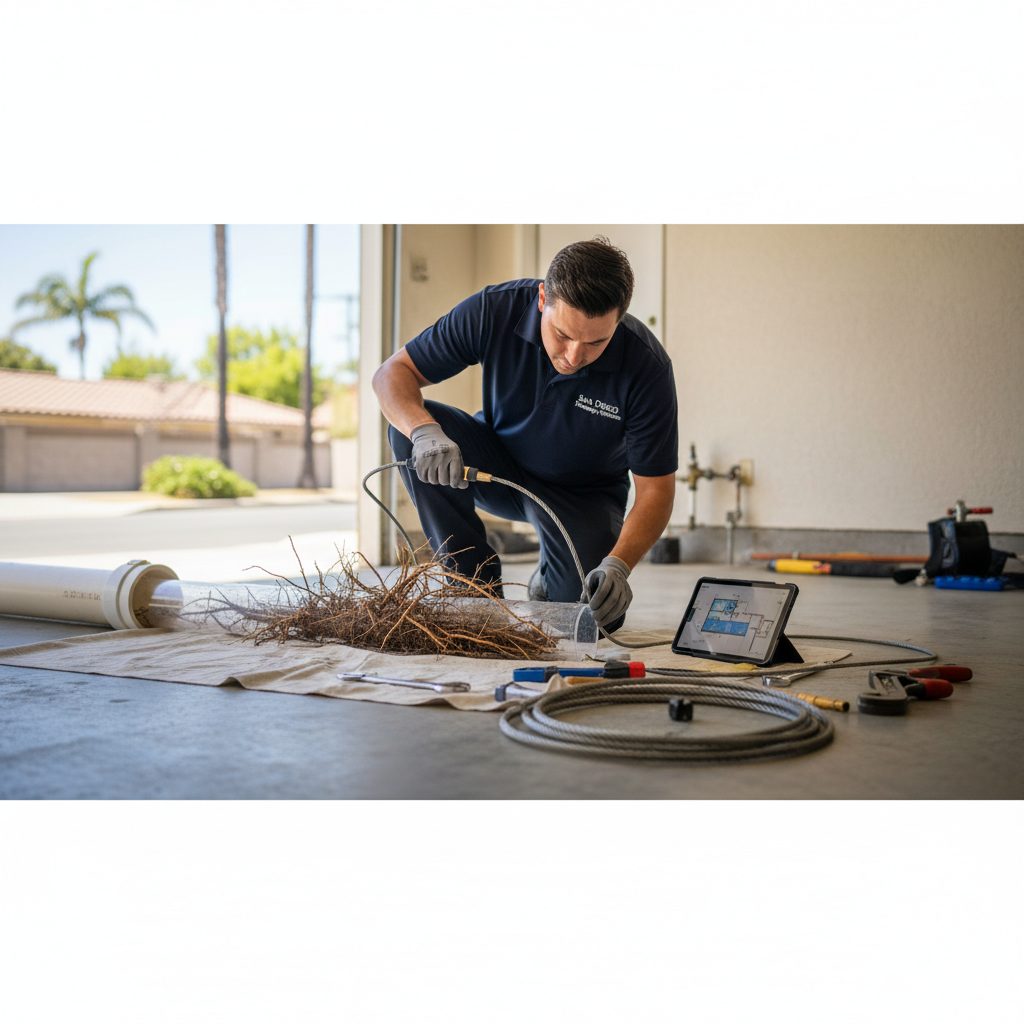
A cable machine (snake) cuts a hole through the blockage. The water flows again. Most of the debris and root mass stays on the pipe walls.
A hydro-jet uses 3,000 to 4,000 PSI of water through a forward-and-rear-facing nozzle. It scours the pipe wall, flushes root hair downstream, and pulls grease and scale off the inside of cast iron. It restores the full inside diameter of the line.
For routine maintenance on a main sewer lateral, hydro-jetting wins. Snaking is fine for an emergency clog, but it’s a temporary fix. We cover the full comparison in our drain cleaning guide and the hydro-jetting walkthrough.
Signs you need it cleaned now, not on schedule
Don’t wait for the calendar if any of these show up.
Multiple fixtures backing up at once. If you flush the toilet and the shower gurgles, or the kitchen sink drains into the laundry standpipe, the blockage is in the main line, not in one fixture.
A repeated gurgle from a toilet or floor drain. That’s air pulling through a partial blockage downstream.
Sewer-gas smell inside or outside the house. A clogged vent or a cracked lateral can both push gas back into the home. Don’t ignore it.
Soft spots, wet spots, or unusually green patches in the yard along the lateral run. That’s exfiltrating sewage feeding the soil. It’s also a sign the pipe is broken, not just clogged.
Slow drainage everywhere in the house at once. One slow sink is a fixture problem. Every drain slow at once is a main-line problem.
If you see any of these, call us. The longer a partial blockage sits, the more pressure builds against weak joints. We’d rather hydro-jet a line at 7 PM than dig one up at 3 AM.
What scheduled maintenance actually costs
The math here is simple and worth doing.
A scheduled hydro-jet on a residential main sewer lateral in San Diego runs roughly $375 to $650, depending on access, line length, and whether a cleanout is already installed. Add a camera inspection every 3 to 5 years for $200 to $400. Call it $500 a year on the high side, or $1,500 over three years with a camera in the mix.
An emergency call-out for a backed-up main is a different number. After-hours dispatch, urgent labor, water-damage cleanup if the line backed up into the house, and possible spot repair if the line is compromised, you’re looking at $1,200 to $3,500 for one incident. A full lateral replacement runs $6,000 to $25,000 depending on length, depth, and method.
Preventative maintenance isn’t expensive. Reactive emergency work is. And in a county where the homeowner is on the hook for the entire lateral, the math favors keeping the line clean.
For more on real-world pricing, see our plumber cost guide for San Diego.
A note on who’s responsible for what
A common question we get: “Doesn’t the city clean the sewer?”
In the City of San Diego and across the surrounding agencies (Helix Water District, Otay Water District, Padre Dam, Olivenhain, and the smaller districts), the public agency is responsible for the sewer main running under the street. The homeowner is responsible for the lateral, the pipe that runs from your house to that main. That lateral usually includes the section under the sidewalk and the parkway, all the way to where it ties into the city main.
That means if a tree root grows into your lateral 20 feet inside the city parkway, it’s still your bill. Some agencies will respond if raw sewage is visibly surfacing in the public right-of-way, but they won’t clean a line on a maintenance schedule. That’s on you.
This is why most San Diego homeowners we serve put their lateral on a routine schedule and forget about it. The cost of a yearly hydro-jet is small. The cost of a Saturday-night backup with sewage on a finished floor is not.
FAQs
Does the city clean my sewer lateral?
No. The City of San Diego and the surrounding water and sewer agencies are responsible for the main under the street. The lateral from your house to that main, including the section under the sidewalk, is yours.
Do roots grow back after they’re cut?
Yes. Mechanical root cutting removes what’s in the pipe today. The root system outside the pipe is still alive and still drawn to the moisture and nutrients inside. Hydro-jetting clears the line more thoroughly than snaking, but the only permanent fix is sealing the cracks or replacing the pipe. Trenchless lining is a good middle option.
Can I prevent root invasion without replacing the pipe?
Partially. Foaming root inhibitors applied annually slow regrowth. Removing problem trees within 30 feet of the lateral helps. Sealing identified cracks with a CIPP liner stops the entry point. None of these are as effective as replacement, but they buy time. We cover this in tree roots in sewer line.
What damages a sewer line fastest?
Three things, in order. Root intrusion at joints. Hydrogen sulfide corrosion in cast iron over decades. And ground movement on slope lots that creates bellies or breaks the pipe outright. Grease and “flushable” wipes are blockage causes, not pipe-damage causes.
Do I need a permit to clean my sewer line?
No. Cleaning, jetting, and camera work don’t require permits. Repair or replacement of any portion of the lateral does. The City of San Diego pulls permits for any lateral replacement that touches the public right-of-way.
Can I clean my main sewer line myself?
You can rent a residential drain machine and clear a soft clog. You cannot replicate a professional hydro-jet at home, and you shouldn’t try. Residential rental snakes don’t have the torque to break through a serious root mass, and they don’t tell you what’s happening 40 feet down the line. They also damage older clay pipe pretty easily. For the main lateral, hire it out.
What to do next
If you don’t know when your sewer line was last cleaned, or if you don’t know what kind of pipe is under your yard, that’s the first thing to fix. A 30-minute sewer camera inspection answers both questions and sets your maintenance schedule for the next decade.
If you’re on a known root-prone lot or in one of the older neighborhoods above, get on a 12-month hydro-jet schedule and stop thinking about it.
If you’re seeing any of the warning signs in this post, don’t wait for the calendar.
We service the full county. Call (858) 925-5546 or visit our sewer line repair page for more on what we do. If you want to compare this to fixture-drain maintenance, our drain cleaning frequency guide covers that side of the system.
Need a Plumber in San Diego?
Licensed, insured, and available 24/7 across San Diego County. Upfront pricing, no surprises.
Call (858) 925-5546Available 24/7, no voicemail, no answering service