
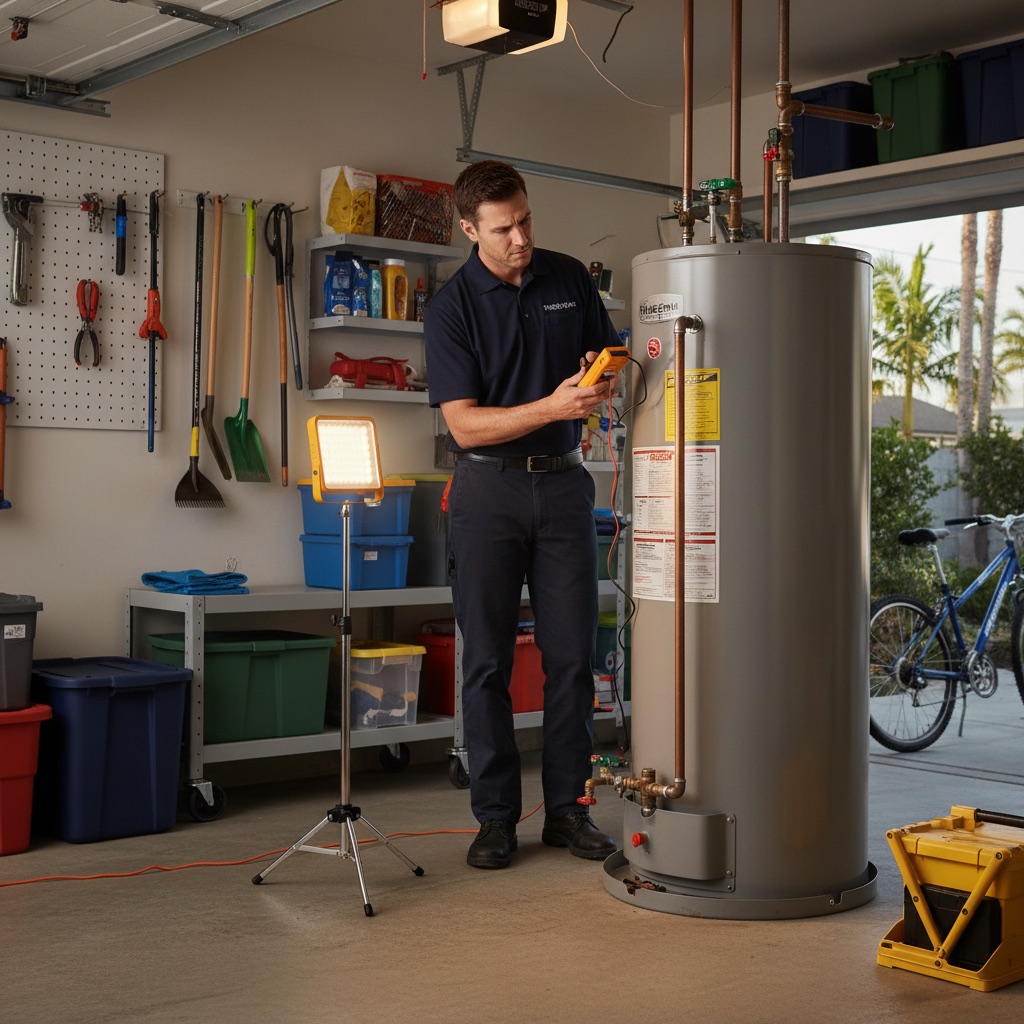
No Hot Water in San Diego? Diagnose It Fast (2026)
No hot water in San Diego? A 60-second triage by heater type, plus brand-specific fixes for Bradford White, Rheem, Navien, Rinnai, and AO Smith units.
The short answer
- Triage fast: is the water cold or lukewarm, did anything change last night (outage, breaker, gas shutoff), and how old is the unit.
- Gas tank fixes: relight the pilot, reset the control board after a power blip, or bleed air from the gas line after an SDG&E shutoff.
- Electric tank fixes: reset the tripped breaker or the red high-limit button, or replace a burned-out heating element.
- Tankless units show an error code; San Diego's top cause is scale on the heat exchanger, so annual descaling is a requirement, not optional.
- Stop and call now if water pools at the tank base, you smell gas, or you hear loud popping; reach us same-day at (858) 925-5546.
You woke up, turned on the shower, and the water never warmed up. Before you call anyone, you can narrow the problem down in about 60 seconds. The fix depends entirely on what kind of water heater you own, and San Diego homes run all five of the common types.
This guide walks you through the triage in order. Find your heater type, then jump to the section that matches.
60-second triage
Three questions sort most calls:
- Is the water cold, or just lukewarm? Stone-cold usually means the heater stopped firing. Lukewarm means it is firing but something is wrong with delivery or temperature control.
- Did anything change last night? An SDG&E outage, a tripped breaker, or a gas company line shutoff can all kill a heater quietly.
- How old is the unit? Past year ten in San Diego, replacement enters the conversation. Our hard water shortens the lifespan compared to national averages.
Hold those answers in your head. Now identify the heater.
Identify your water heater type
Walk to the unit. It is usually in the garage, a utility closet, the attic, or mounted on an exterior wall.
Gas tank. A vertical cylinder, 40 to 75 gallons, with a flue pipe going up through the roof and a gas line coming in at the bottom. You will see a control valve and a small access panel near the floor.
Electric tank. Same vertical cylinder, but no flue and no gas line. Instead you will find an electrical conduit feeding into the top and access panels on the side covering the heating elements.
Gas tankless. A small wall-mounted box, usually 18 to 24 inches tall, with a gas line, a vent pipe out the side or top, and water lines below. Navien, Rinnai, Noritz, and Takagi are the brands you will see in San Diego.
Electric tankless. Smaller than gas tankless, no vent pipe at all, with a heavy electrical feed. Less common here but they show up in coastal condos.
Heat pump. Looks like an electric tank but with a fan unit on top that pulls heat from surrounding air. Often labeled “hybrid.” AO Smith Voltex and Rheem ProTerra are the common units locally.
Got it? Now go to your section.
Gas tank water heater: no hot water troubleshooting
Open the access panel near the bottom. You are looking for a flame or a pilot light.
Pilot is out. On older units with a standing pilot, the flame may have blown out. Relight it per the instructions on the label. If it lights and then dies within seconds, the thermocouple is failing. We cover this in detail in our pilot light troubleshooting guide. It is the most common no-hot-water call we run.
Electronic ignition, no spark. Newer Bradford White and AO Smith units use a hot surface igniter or spark. After an SDG&E power blip, the control board sometimes fails to reset. Cut power at the dedicated outlet or breaker for 60 seconds, then restore. If the igniter still does not fire, the gas valve assembly or board has failed. That is a $350 to $650 repair.
Gas valve clicked off. SDG&E does periodic line work in older San Diego neighborhoods. If your gas meter was shut off and turned back on, air in the line will cause the heater to lock out after three failed ignition attempts. Hold a lit burner on the stovetop for a minute to bleed the line, then reset the heater.
Burner fires but water stays cold. This is a dip tube failure. The cold inlet tube delivers cold water to the bottom of the tank for heating. If it breaks, cold water mixes at the top and exits as lukewarm. Bradford White had a known dip tube defect on units built in the mid-1990s, and we still see it on older San Diego homes that have never replaced the heater.
Sediment is suffocating the burner. San Diego water averages 17 grains per gallon of hardness, more than three times the national average. Calcium and magnesium settle to the bottom of the tank and form an insulating crust over the burner. The burner fires but heats sediment instead of water. You can hear it: popping, rumbling, or a kettle-like roar. Flushing helps if you catch it early. If the tank is more than 8 years old and you have never flushed it, replacement is usually the right call. More on the cost math in our water heater replacement cost guide.
If the bottom of the tank is wet, stop. You have a leak, not a heating problem. Read what to do when your water heater is leaking and call us.
Electric tank water heater: no hot water troubleshooting
Electric tanks are simpler, and that helps you diagnose without tools.
Breaker tripped. Find the dedicated double-pole breaker in your panel labeled “water heater.” If it is in the middle position or flipped off, reset it. If it trips again immediately, one of your heating elements has shorted. Stop and call. A shorted element with a damaged tank can become a shock hazard.
Reset button popped. Pull the upper access panel off the side of the tank. Behind the insulation, you will see a small red button on the high-limit switch. Press it firmly. If you hear a click, it had tripped. This happens when water inside the tank exceeded 180 degrees, which usually means a stuck thermostat. The fix is replacing the thermostat, about $200 to $350 installed.
Burned-out heating element. Most electric tanks have two elements, upper and lower. If only the upper element works, you get a few gallons of hot water then it goes cold. If only the lower works, you get a long wait and lukewarm output. Replacing an element is straightforward but San Diego’s hard water destroys elements faster than the national average. Sediment cakes onto the element and causes it to overheat and fail. If your tank is past year 8 and an element has failed, weigh repair against replacement.
Both thermostats reading correctly but no heat. Less common. Usually a wiring fault between the upper thermostat and the lower element, or a corroded terminal. Coastal-air homes in Imperial Beach, Ocean Beach, and Cardiff see this more often than inland properties.
Tankless water heater: no hot water troubleshooting
Tankless units talk to you. Look at the digital display.
Error code displayed. Write it down. Common ones in San Diego:
- Navien 12, 14, 16: flame loss or overheat. Often gas pressure or scale.
- Rinnai 11: no ignition. Gas supply or igniter.
- Noritz 11, 12: flame failure.
- Takagi 111, 121: ignition or flame loss.
Our tankless water heater repair guide covers each code in depth. Most San Diego tankless calls trace back to one of three causes: scale buildup on the heat exchanger, vent obstruction, or low gas pressure.
Scale buildup. This is the San Diego tankless killer. Hard water deposits coat the heat exchanger and reduce heat transfer. Within two years of unflushed operation, a Navien or Rinnai unit will start throwing flame or overheat codes. Annual descaling is not optional here. It is a maintenance requirement.
Coastal corrosion. Outdoor-mounted tankless units in La Jolla, Del Mar, Encinitas, Coronado, and Point Loma corrode faster than inland installs. Salt air attacks the vent terminals, the cabinet, and the circuit board. If you live within a mile of the ocean and your tankless is mounted outside, expect a 12 to 15 year service life instead of the manufacturer’s stated 20.
Vent blocked. Birds nest in tankless vent caps. Spiders build webs across the intake. After any flame-related error code, walk outside and look at the vent terminal.
Heat pump water heater: no hot water
Heat pump units are great for our climate but they have specific failure modes.
Compressor locked out. The unit will switch to backup electric resistance heating, which is slow and expensive. Check the display for a fault code. AO Smith Voltex and Rheem ProTerra both display compressor faults plainly. Common cause is the condensate drain clogging and triggering an overflow safety switch.
Condensate drain clogged. The heat pump pulls humidity out of the surrounding air. That water drains away through a small tube. In a garage installation, dust and debris clog the drain within a year or two. When the pan fills, the unit shuts off the compressor. Clear the drain, dry the pan, and restart.
Ambient temperature too low. Heat pumps need 40 to 90 degrees of surrounding air to run efficiently. San Diego garages stay in range almost year-round, but an attic install in summer can hit the upper limit. The unit will switch to resistance mode and your power bill will spike.
Lukewarm but not hot: a different problem
If the water is warm but not actually hot, your heater is firing. The problem is somewhere else.
Dip tube failure. Same as the gas tank section. Cold inlet water mixes with hot at the top of the tank.
Thermostat set too low. Check the dial. The factory default on most San Diego installs is 120 degrees. Some plumbers crank it down to 110 to limit scald risk for kids and elderly residents. Bumping it to 120 is safe and usually solves the lukewarm complaint.
Mixing valve stuck. Some homes have a thermostatic mixing valve at the tank that blends hot and cold to deliver a safer output temperature. When the valve fails, it leaks cold into the hot line. The fix is replacing the valve, about $250 to $400.
Recirculation pump failed. Homes with hot water recirculation lines (common in larger La Jolla and Rancho Santa Fe homes) can develop a pump failure that pulls cold back into the hot line. Often misdiagnosed as a heater problem.
When to repair vs replace
The math in San Diego is harsher than the national average because of our water.
For a gas tank under 8 years old, repair. Past 10, weigh the repair against the replacement quote. If repair is more than 50% of replacement cost, replace. Tanks past 12 years are on borrowed time here.
For a tankless past 12 years, the heat exchanger is the make-or-break component. Heat exchanger replacement runs $800 to $1,800. A full replacement runs $2,800 to $4,200. Replace.
For a heat pump, the compressor is the expensive component. Compressor failure on a unit past 8 years usually means replacement.
Full breakdown in our water heater cost guide and the life expectancy article.
Signs you have an emergency, not just no hot water
Some symptoms mean stop diagnosing and call right now.
Water pooling at the base of the tank. That is a tank failure or a connection leak under pressure. Shut the cold water inlet off above the tank and call.
Gas smell. Leave the house, call SDG&E from outside at 800-411-7343, then call us once gas is shut off.
Loud popping, rumbling, or kettling. Heavy sediment is overheating. The tank can fail catastrophically. More on the noise diagnosis in our water heater noise guide.
Sweating tank. Condensation on the outside of a gas tank can indicate a slow internal leak.
Soot or scorch marks around the burner. Combustion problem. Shut off the gas at the heater and call.
FAQ
How long should I wait for hot water to come back if my heater just lost power? A 50-gallon gas tank reheats from cold in 45 to 60 minutes. An electric tank takes 60 to 90 minutes. Tankless is instant once power and gas are restored.
Will SDG&E outages damage my water heater? Short outages, no. Long outages combined with surges when power returns can damage control boards on tankless units and on newer gas tanks with electronic ignition. A small surge protector at the heater’s outlet is cheap insurance.
Is it safe to keep using cold water while I wait? Yes. Cold water lines are not affected. Just avoid running the dishwasher or washing machine until you confirm the heater is back online.
Why does my hot water run out faster than it used to? Sediment buildup reduces effective tank capacity. A 50-gallon tank with 5 years of unflushed sediment may have only 35 gallons of usable hot water. San Diego homes need annual flushing to maintain capacity.
My water heater is making a popping sound but still works. Urgent? Not urgent, but plan it. Popping means sediment is boiling water trapped underneath. Get it flushed within the month, or budget for replacement if it is past year 10.
Still no hot water?
If you have worked through this guide and the heater is still cold, our water heater repair team can be at your San Diego home today.
Call (858) 925-5546. We run gas, electric, tankless, and heat pump diagnostics, carry parts for Bradford White, AO Smith, Rheem, Navien, Rinnai, Noritz, and Takagi on the truck, and serve all 47 cities in San Diego County.
No upcharges for evening or weekend calls. We give you the diagnosis and the repair-vs-replace math before any work begins.
Need a Plumber in San Diego?
Licensed, insured, and available 24/7 across San Diego County. Upfront pricing, no surprises.
Call (858) 925-5546Available 24/7, no voicemail, no answering service