Best Clogged Drain Repair in San Diego (2026 Guide)
How to pick the best clogged drain repair in San Diego. Match the method to your clog, avoid bait pricing, and ask the right questions first.
The short answer
- The best repair is a method matched to your clog pattern, not a brand; diagnose before you call.
- One slow fixture is a branch-line clog; multiple fixtures backing up at once is a sewer lateral problem needing a specialist.
- Snake a local mechanical clog; hydro-jet buildup along the pipe wall; always camera a mainline before aggressive work.
- Skip chemical drain cleaners; they corrode older San Diego pipe and make the plumber's job harder.
- Costs: branch snake $150 to $325, mainline snake $250 to $750, hydro-jet $400 to $1,200. Anything under $100 is bait. Call (858) 925-5546.
The best clogged drain repair in San Diego isn’t a brand. It’s a method, matched to your specific clog pattern, run by a specialist who owns the right tool. A single slow sink and a full-house sewer backup are different jobs. This guide walks you through diagnosing the clog yourself, picking the right method, and screening the company before they show up.
Diagnose the clog first: 5 patterns and what they mean
Before you call anyone, figure out which pattern you have. The pattern tells you what’s clogged, where it sits in the system, and which specialist you actually need.
Pattern 1: Single fixture, slow drain. One sink, tub, or shower drains slowly. Everything else works. The clog is almost always in the fixture’s trap or the short branch line under the floor. Hair, soap, grease, or a dropped object. This is a 30-minute job for a competent plumber with a hand snake.
Pattern 2: Single fixture, full backup. Water won’t go down at all. Same diagnosis, but the clog is denser. Still a branch-line problem. Don’t let anyone sell you mainline service here.
Pattern 3: Multi-fixture, same room. Tub and bathroom sink back up at once. The clog is downstream of where those two lines join, upstream of the rest of the house. Often the wet-vent or bathroom group line. Mid-line snake job.
Pattern 4: Full-house slow. Every drain empties slowly. Toilets gurgle when the washer runs. Partial mainline restriction. Grease, scale, or early root intrusion. Camera first, then jet or snake.
Pattern 5: Full-house backup. Wastewater comes up in the lowest fixture when you flush a toilet. This is the sewer lateral. Stop using water. You need a sewer specialist with a camera and mainline machine, not a drain guy.
Get the pattern right and you’ve already cut your repair cost in half.
Methods matched to clog patterns
Every clog has a right tool. Most overpriced repairs happen when a company brings the wrong one and bills you for the difference.
A plunger still works on toilets and single sinks when the clog is close. Don’t skip it.
A hand snake (1/4-inch cable, 25 feet) clears most bathroom branch lines. Hair and light soap scum.
A drum auger (3/8-inch cable, 50 to 75 feet) handles longer branch runs and kitchen lines. Cuts compacted food waste and grease.
A mainline snake (5/8 to 3/4-inch cable, 100-plus feet) is for sewer laterals. Bigger motor, heavier cable, root-cutting heads.
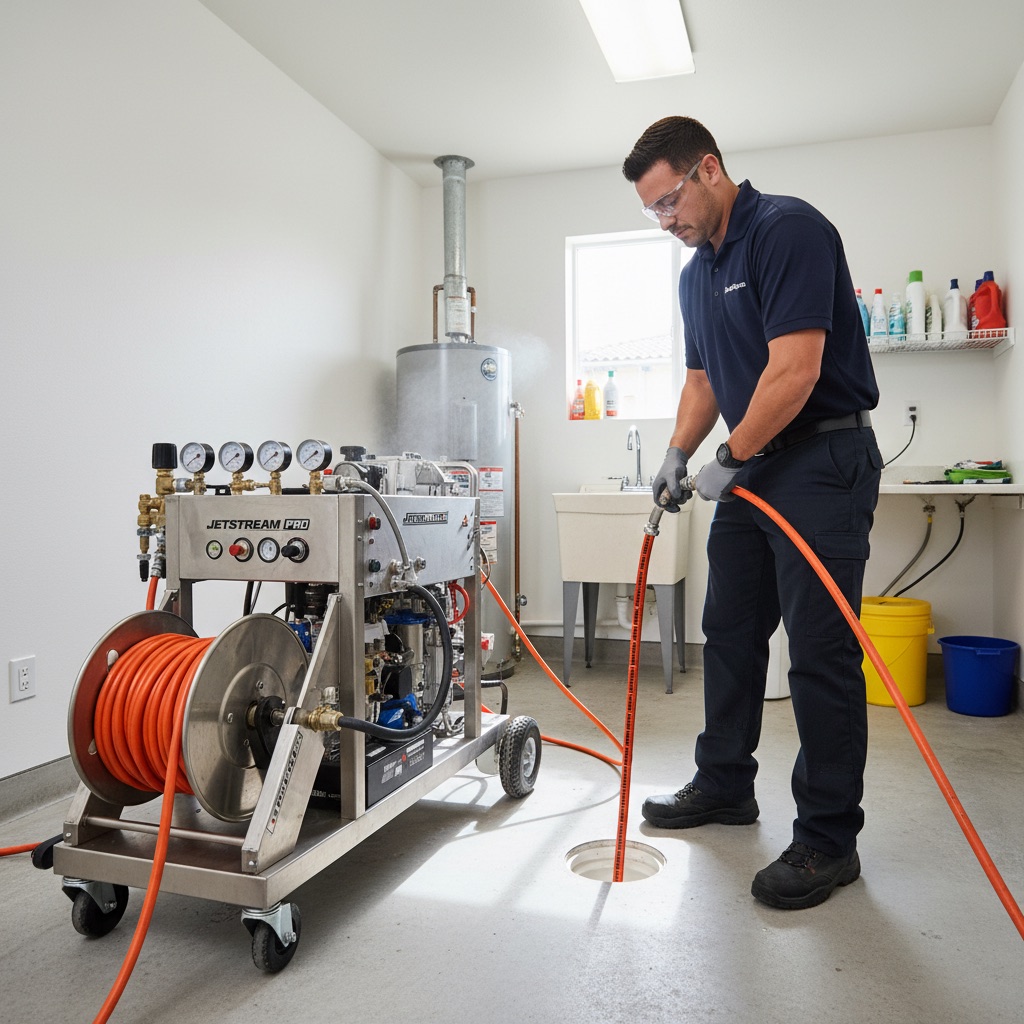
A hydro-jet scours pipe walls clean with 1,500 to 4,000 PSI of water. Best for grease, scale, and recurring clogs. It clears the pipe, not just a hole through the clog. See our hydro-jetting in San Diego deep dive.
A descaling chain grinds hard mineral buildup off the inside of cast iron sewer lines. Older San Diego homes often need this before any other method works.
A root cutter is a specialty head on a mainline machine or jet. Cuts live roots back to the pipe wall. Roots grow back. Cutting buys you 12 to 36 months.
A company that only owns a snake will sell you a snake job whether it fits or not.
Why chemical drain cleaners are the wrong call
Liquid drain cleaner is the most damaging product on a hardware store shelf. Strong sulfuric or sodium hydroxide. It generates heat. It eats the clog, then it eats the pipe.
In galvanized steel lines common in pre-1960 San Diego homes, the chemical accelerates corrosion. In cast iron, it scars the interior wall and creates rough spots that catch the next clog faster. In old PVC and clay laterals, the heat softens joints and degrades gaskets.
Then the plumber arrives. There’s a pool of caustic liquid in the trap. When the snake spins, the chemical sprays. Real plumbers refuse to work a treated line, or they charge a hazmat surcharge. You’ve made the job worse and more expensive.
Use an enzyme-based maintenance product if you want something off a shelf. Enzymes eat organic buildup over weeks and don’t damage pipe.
Hydro-jet vs snake: when each fits
The short version. A snake punches a hole through the clog. A jet cleans the whole pipe.
Use a snake when the clog is mechanical and local. Hair in a shower drain. A toy in a toilet trap. Roots that need cutting. The snake is fast and cheap.
Use a jet when the clog is buildup along the pipe wall. Kitchen grease coating 30 feet of branch line. Mineral scale in a cast iron sewer. Recurring slow drains in the same fixture every few months.
Don’t jet old, fragile pipe without a camera first. High pressure water in a corroded cast iron lateral can blow out a weak joint. A pro looks at the line before deciding. For the longer breakdown, read our drain cleaning in San Diego post.
Camera-first vs snake-first companies
Two kinds of drain companies exist in San Diego. The ones that own a camera and the ones that don’t.
Camera-first companies inspect before they cut. They show you the clog, tell you the pipe material and slope, and give you a recording. Repairs are scoped to what’s actually wrong.
Snake-first companies cable the line, declare it clear, and leave. If the clog comes back in three months they’ll cable it again for another fee. They never tell you why because they don’t know.
Insist on a camera inspection before any mainline work. Many companies include it free with a clearing job. Ask. If the company doesn’t own a camera, that’s not the company you want past a basic bathroom clog. See how often sewer lines should be cleaned.
Cost expectations by method
Real San Diego ranges, accurate for 2026. Use these to spot bait pricing.
- Branch-line snake (single sink, tub, shower): $150 to $325
- Toilet auger: $175 to $300
- Mainline snake through a cleanout: $250 to $475
- Mainline snake with no accessible cleanout: $400 to $750
- Camera inspection alone: $250 to $450, often credited toward repair
- Hydro-jetting a branch line: $400 to $700
- Hydro-jetting a mainline: $550 to $1,200
- Descaling cast iron: $900 to $2,500 depending on length
- Root cutting: bundled with mainline service, $475 to $900
Anything advertised at $49, $79, or $99 is bait pricing. The real number lands after the truck rolls and the tech finds a reason to upsell.
Red flags in a drain repair quote
Watch for these. Any one of them should slow you down.
A door-to-door pitch. Real plumbers don’t drive neighborhoods knocking.
Bait pricing under $100. The job will end at three to ten times that number. Pulled-bait pricing is the oldest move in the trade.
No camera offered on a mainline job. You’re being sold a temporary fix. The clog is coming back.
No written warranty on the clearing. A real shop warranties a snake job for 30 days and a jet job for 90 days, at minimum.
A flat refusal to break out cost by method. “It’s $850 to fix your drain” is not a quote. “It’s $325 to snake, $675 to jet, $450 for camera, here’s why I’d start with the snake” is a quote.
Pressure to sign on the spot. Decent companies give you a written estimate and walk away to let you think.
A pitch for a full repipe after one visit, with no camera footage to back it. Repiping is a real repair. It shouldn’t be the first answer.
Specialist matching: when you need a sewer guy, not a drain guy
This is the most common mistake homeowners make. They call a general handyman or a low-bid drain service for what’s actually a sewer lateral problem.
A drain guy clears branch lines under sinks, in walls, in floor drains. Hand snake, drum auger, basic camera if they have one. Good for patterns 1, 2, and 3 from earlier in this guide.
A sewer specialist owns a mainline machine with a 3/4-inch cable, a mainline camera with locator, a hydro-jet rated for 4,000 PSI, and root-cutting heads. Diagnoses lateral structural problems. Knows when a clearing fix has run out and a spot repair or trenchless liner is the right call. Required for patterns 4 and 5.
If you have multi-fixture backup, low spots on a camera image, or a slow drain that comes back every 6 to 12 months, you have a lateral issue. You need the sewer specialist. The drain guy will keep selling you the same snake job until the line collapses.
DIY methods that work before you call
For a single slow drain, try this in order before you book service.
Boiling water plus dish soap for kitchen grease. Pour a quart of boiling water down the drain, follow with a squirt of dish soap, wait five minutes, follow with another quart of hot tap water. Works on light grease coatings.
Baking soda and hot water for shower and tub clogs. Pour a cup of baking soda, follow with two cups of hot water, wait 15 minutes, flush with hot tap water. Skip the vinegar combo. It looks dramatic but neutralizes itself. The science is covered in baking soda and vinegar drain cleaning.
Enzyme cleaner for chronic slow drains. Pour overnight. Works in 7 to 14 days of regular use. Won’t damage anything.
A drum-style hand auger ($25 at the hardware store) for known hair clogs in a shower or sink. Pull the stopper, feed the cable 15 to 20 feet, retrieve the wad. Effective and surprisingly satisfying.
What to skip: liquid chemical drain cleaner, a bent coat hanger, and a wet-dry vacuum on a suspected sewer backup. For a routine maintenance schedule that prevents most of this, see how often to clean drains and how to prevent clogged drains.
If DIY doesn’t clear it in two attempts, stop. You’re not making it better.
Questions to ask before they roll the truck
Use this short list on the phone. The answers tell you everything.
What method will you start with, and what does it cost?
Do you own a sewer camera, and is the inspection included if I book a clearing?
What’s the warranty on the clearing? In writing?
If the snake doesn’t clear it, what’s your next step and what does that cost?
If you find a structural problem on camera, can you give me a written report with the footage?
Is the price you’re quoting the price I’ll pay, or is it the starting price?
A real drain company answers these without hesitation. A bait shop hedges, transfers the call, or quotes “it depends” on all of them.
Frequently asked questions
Q: How do I know if it’s a branch-line clog or a sewer lateral clog? If only one fixture is affected, it’s a branch-line clog. If multiple fixtures back up at the same time, especially across rooms, it’s the lateral. Use the 5 patterns at the top of this post.
Q: How long should a clogged drain repair take? A simple branch line is 30 to 60 minutes. A mainline snake is 1 to 2 hours. A jet plus camera runs 2 to 3 hours. Anything advertised as “10 minutes flat” is selling a bait fix.
Q: How often do I need drain cleaning if I have older cast iron lines? Every 2 to 3 years for a preventive hydro-jet or descaling, depending on use and condition. A camera inspection every 5 years catches scale and joint problems early.
Q: Will a clogged drain fix itself? No. Soft clogs sometimes pass with enough hot water, but the buildup that caused it stays on the pipe wall. Untreated clogs get worse. They don’t get better.
Q: Is a $99 drain cleaning special legitimate? Almost never. It’s a foot-in-the-door price. The real bill arrives after the tech finds “additional work” required. Ask for the all-in price over the phone.
Q: Do I need a permit to repair a clogged drain in San Diego? No permit for clearing or cleaning. A permit is required for spot repairs, lateral replacements, or trenchless lining work. Any company doing structural sewer work without pulling a permit is a problem.
Q: My drain clears but the clog comes back every few months. What’s going on? That’s a buildup pattern, not a clog pattern. A snake is punching a hole through a wall coating that reforms quickly. You need a hydro-jet or descaling, plus a camera to confirm the cause.
The bottom line
The best clogged drain repair in San Diego is the one that fits your specific clog, uses the right tool the first time, and includes a camera if it’s anything past a basic fixture clog. Diagnose the pattern, pick the method, screen the company on the phone, and you’ll pay a fair price for a job that holds.
If you’re not sure what pattern you have or which method fits, call Plumbing Pro San Diego at (858) 925-5546 or start with our drain cleaning service. We’ll walk through your symptoms, give you a real per-method quote, and bring a camera on any mainline work. No bait pricing, no door-to-door, no chemical sales.
For city-specific guidance, see our clogged drain repair in La Mesa and drain cleaning cost in Carlsbad pages. For the broader buying guide, read best drain cleaning in San Diego.
Need a Plumber in San Diego?
Licensed, insured, and available 24/7 across San Diego County. Upfront pricing, no surprises.
Call (858) 925-5546Available 24/7, no voicemail, no answering service