
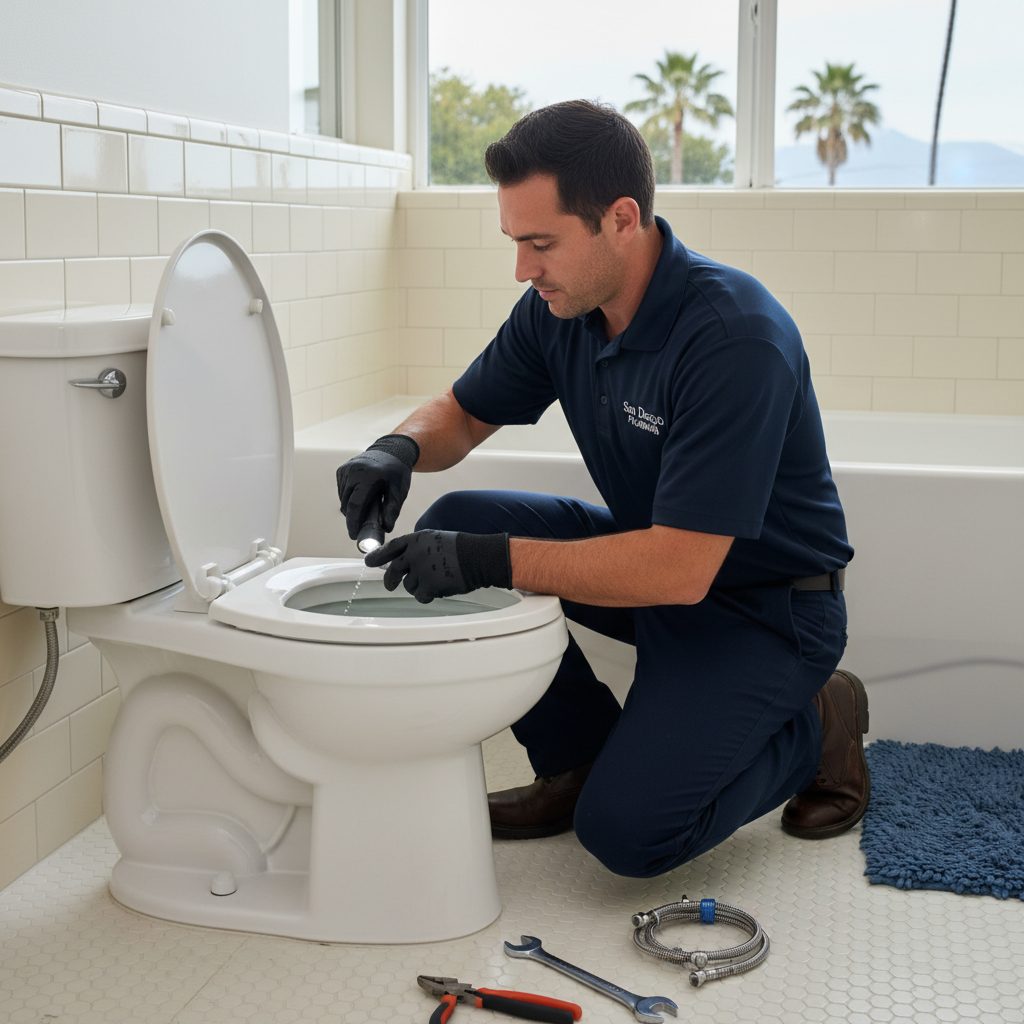
Best Toilet Repair in San Diego: How to Choose (2026)
How to pick the best toilet repair in San Diego. Diagnose your problem, know when to DIY, spot upsell traps, and find a plumber who fixes instead of replaces.
The short answer
- Most toilet problems are cheap fixes; a running tank or ghost flush is usually a worn flapper you can swap for $5 to $25.
- Tank guts are DIY; anything below the flange (wax ring, subfloor, hidden leaks) is a pro job.
- Most repairs run $150 to $450 all-in; flange repair with subfloor work climbs past $500.
- The best plumber tries to fix before replacing and carries common parts on the truck; walk from any flat $400 minimum or replace-first pitch.
- San Diego's hard water kills rubber flappers in 3 to 5 years and scales fill valves. Call (858) 925-5546.
Most toilet problems are cheap fixes hiding behind dramatic symptoms. A running tank, a weak flush, a small puddle at the base. Half of these you can handle yourself with a $12 part from any hardware store. The other half need a plumber who’s willing to fix the toilet instead of selling you a new one. Knowing which is which is the whole game.
Diagnose first: what’s actually wrong with your toilet
Before you call anyone, figure out the symptom. The fix follows the diagnosis.
Running toilet. Water keeps cycling into the bowl long after the flush. Usually a worn flapper or a stuck fill valve. Cheap fix. We wrote a full breakdown on why your toilet keeps running.
Leaking at the base. Water pools on the floor around the toilet after every flush. That’s almost always a failed wax ring or a cracked flange. Wax ring is easy. Flange repair gets complicated if the subfloor is rotted.
Weak or partial flush. The bowl empties slowly or needs two flushes. Could be clogged rim jets from hard water, a bent flapper chain, or a partial blockage in the trapway.
Ghost flush. The tank refills on its own every few minutes with nobody around. Slow leak from the tank to the bowl, almost always the flapper.
Rocking toilet. The whole fixture wobbles when you sit. Loose closet bolts at best, broken flange at worst.
Sweating tank. Condensation drips off the porcelain in humid coastal weather. Not a leak, but it can rot a bathroom floor over time.
Constant clogs. If the same toilet clogs every week, it’s either a low-flow first-gen toilet, a partial trapway obstruction, or a venting issue. Our unclogging guide covers the at-home fixes first.
If you don’t know which symptom you have, a good plumber will tell you over the phone for free.
When DIY makes sense and when it doesn’t
Toilet repair has a clean dividing line. Tank guts are DIY. Anything below the flange usually isn’t.
Easy DIY: Flapper replacement, fill valve replacement, flush handle fix, supply line swap, toilet seat replacement. Parts are $5 to $25. Tools are a wrench and your hands. Most homeowners can do these in under an hour. We have a step-by-step on the flush handle repair if that’s your issue.
Borderline: Wax ring replacement. The physical work is simple. The risk is dropping a 70-pound porcelain bowl on your foot or cracking it on reinstall. If you’ve never lifted a toilet, this is the one to think twice about.
Call a pro: Flange repair, subfloor rot, hidden leaks behind the wall, cracked tanks, lead-bend drains in homes built before 1960, and any repair where you’re three steps in and water is everywhere.
Almost always pro: Full toilet replacement. The toilet itself is light. The drain alignment, flange height, and floor leveling are where amateur installs leak six months later.
The honest rule: if you’ve watched two YouTube videos and you still don’t know what part you need, stop and call. The diagnostic call is cheaper than the water damage.
What “best” means for toilet repair in SD
Best isn’t a Yelp ranking. It’s a set of behaviors you can spot in the first phone call.
A good toilet repair plumber will try to fix before they replace. If your toilet is a Kohler from 2008 and the flapper is shot, the right move is a $15 flapper, not a $700 new toilet. A plumber who skips straight to “we’d recommend a full replacement” without diagnosing is selling, not fixing.
Transparent pricing matters. You want a flat-rate diagnostic fee that’s waived if you do the repair, then a clear quote for the work. Hourly with no cap is how small jobs become big bills.
Parts on the truck is underrated. The best toilet repair techs carry universal flappers, common fill valves, wax rings, supply lines, closet bolts, and the most common Kohler and American Standard cartridges. If the plumber has to leave to get a $3 part, you’re paying for that drive.
San Diego has a lot of older housing stock with 10-inch rough-in toilets. New toilets default to 12-inch. A plumber who knows this and brings the right model or the right adapter saves you a return trip.
Willingness to work in tight half-baths matters. A lot of San Diego homes have powder rooms where you can’t swing a wrench. A repair tech with small tools and patience finishes the job. One without will tell you the toilet has to come out.
Brand-specific repair specialists
Not every plumber knows every brand. Toilet brands use proprietary internals, and the wrong part won’t seal.
Kohler. Common in homes built since 2000. Class Five and Cimarron flush systems use Kohler-specific canister flappers. Most plumbing supply houses in San Diego stock them.
American Standard. Champion 4 series and Cadet Pro models are everywhere in tract homes. Parts are easy. The Champion’s tower-style flush valve fails in a specific way and takes a specific part.
TOTO. Higher-end homes, especially in Rancho Santa Fe, La Jolla, and Del Mar. TOTO parts are harder to source locally. A plumber familiar with TOTO will know which supply house to call. Generic parts often don’t fit.
Gerber. Common in 80s and 90s builds. Reliable but uses some legacy parts that big-box stores don’t carry.
Mansfield. The Alto and 160 series have a unique tower flush valve that confuses plumbers who haven’t seen it. Specific replacement seal, not a universal flapper.
If your toilet is one of these brands, ask the plumber on the phone if they’ve worked on it. A confident “yes, we keep those parts on the truck” is the answer you want.
Cost expectations for toilet repair in SD
Most toilet repairs in San Diego land between $150 and $450 all-in. A flapper or fill valve swap is on the low end. A wax ring with a healthy flange runs $200 to $350. Flange repair with any subfloor work climbs to $500 or more.
Full breakdown: toilet repair cost in San Diego. If you’re already thinking about replacement, toilet installation cost covers that side. For broader pricing context, see how much a plumber costs in San Diego.
Watch for service-call minimums. Many shops charge $89 to $129 just to roll a truck. A fair plumber waives that fee if you book the repair.
When repair becomes replacement
There’s a point where fixing the same toilet for the third time stops making sense. Here’s how to tell.
Age. Toilets made before 1994 use 3.5 gallons or more per flush. New 1.28-gallon models save real money on the water bill. If yours is 20-plus years old and giving you trouble, replacement math gets compelling.
Repeated repairs. If you’ve replaced the flapper twice and the fill valve once in the last two years, the tank is probably warped or the seat is shot. A new toilet costs less than a fourth round of parts and labor.
Hairline cracks. A crack in the tank or bowl is terminal. They spread. Replace before it fails on its own schedule.
Low-flow rebates. The San Diego County Water Authority and several local districts offer rebates on high-efficiency toilet replacements. They don’t cover the install but they shave $40 to $150 off the toilet itself. Worth checking before you buy.
Style and function. If the bowl is small, the seat is uncomfortable, or the flush is loud, no repair fixes that. Replacement is a quality-of-life upgrade.
Red flags in a toilet repair quote
Some quotes tell you everything you need to know in 30 seconds.
Flat $400 minimum. No diagnostic, no parts list, just “we charge $400 to come out and look.” That’s a sales call dressed up as a service call.
Refuses to repair. You describe a running toilet, they quote a full replacement before they’ve seen it. They’re not a repair plumber. They’re a sales rep with a wrench.
No warranty. A real shop warranties parts and labor for at least 30 days, usually 90. If the answer is “we don’t warranty toilet work,” walk.
Vague itemization. “Toilet repair, $475.” No part numbers, no labor breakout, no diagnosis on paper. That’s how surprise charges happen.
Pressure to decide now. “If we leave, the price goes up.” Predatory. A good plumber lets you think.
Cash only. A licensed business takes cards and writes receipts. Cash-only is often unlicensed.
Hard-water effect on toilet parts
San Diego water sits between 250 and 400 ppm hardness in most neighborhoods. That’s hard. It matters for toilets in three ways.
Mineral buildup clogs the rim jets under the bowl rim, which weakens the flush over time. A vinegar soak helps. Severe cases need the jets cleared mechanically.
Hard water eats rubber flappers faster. Where a flapper might last 7 years in soft-water Pacific Northwest, it lasts 3 to 5 here. Plan for it.
Scale builds up in fill valves and slows refill. A fill valve that’s running fine today can choke off in two years without warning. If your tank is refilling slower than it used to, that’s why.
A whole-house water softener slows all of this down. It also extends the life of water heaters, dishwashers, and washing machines. Worth thinking about if you’re already calling a plumber.
Questions to ask before you hire
Ask these on the phone. The answers separate fixers from salespeople.
What’s your diagnostic fee, and is it waived if I book the repair? What brands of toilet parts do you carry on the truck? Do you offer flat-rate or hourly? What’s your warranty on toilet repairs? Have you worked on (your toilet brand) before? Will you try to repair before recommending replacement? What’s a typical price range for (your symptom)?
A confident, specific answer to each one means you’ve found a real repair shop. Vague answers or pressure to book on the spot means keep dialing.
Frequently asked questions
How long does toilet repair take in San Diego? Most repairs take 30 to 90 minutes once the plumber arrives. Flange repair or subfloor work can stretch to 2 to 4 hours.
Can I keep using my toilet while it’s leaking? Short answer, no. A leak at the base damages your subfloor every time you flush. Shut off the supply at the wall valve and use another bathroom until it’s fixed.
Is it worth repairing a 20-year-old toilet? Sometimes. If the porcelain is sound and the issue is a $20 part, yes. If it needs internals plus a flange and you’re paying for two trips, replacement starts to win.
Do plumbers stock parts for older toilets? For Kohler, American Standard, and Gerber, usually yes. For obscure brands or imports, sometimes no. Ask before booking.
Why does my toilet keep clogging after repair? If it clogs weekly, the problem isn’t the toilet itself. Look at the drain line, the vent stack, or the trapway design. A camera inspection finds it fast.
Should I replace both toilets at once? Only if both are giving you trouble. Plumbers will sometimes discount the second install on the same visit. Ask.
A simple way to start
Call the diagnosis in. Tell the plumber the symptom in plain English. A good shop will tell you whether it’s a 10-minute DIY or a service call worth booking. We do this every day for San Diego homeowners, no pressure attached.
If you want a straight answer, call us at (858) 925-5546. We’ll tell you whether it’s worth a truck roll or whether you can fix it yourself in 20 minutes.
Need a Plumber in San Diego?
Licensed, insured, and available 24/7 across San Diego County. Upfront pricing, no surprises.
Call (858) 925-5546Available 24/7, no voicemail, no answering service